
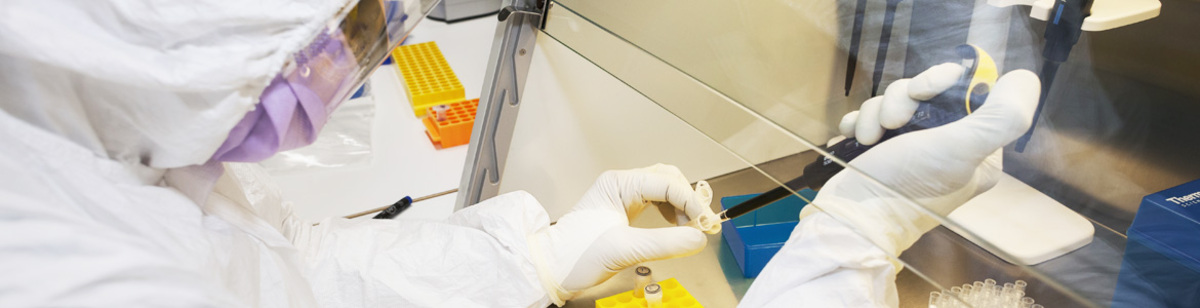
PhD student in Environmental Science focusing on Toxicology
The Department of Environmental Science is one of the biggest departments at the Faculty of Science. The department consists of four units with more than 170 researchers, teachers, doctoral students and technical/administrative staff from over 30 countries. Research and teaching focuses on chemical contaminants, atmospheric science, biogeochemistry and (eco)toxicology. As an employee at the Department of Environmental Science you will be part of a dynamic environment with research in leading research areas and with a strong international profile. For more information about us, please visit: the Department of Environmental Science.
Research at the Unit for Atmospheric Science focuses on topics ranging from the toxicity of airborne pollutants to climate studies. The PhD position advertised here will focus on determining the chemical composition and toxicity of airborne particles originating from various quartz-containing materials, such as artificial stone, concrete, brick, natural stone, and sand.
Project description
Exposure to quartz dust (respirable crystalline silica) in occupational settings is very widespread today, and affects more than 200 000 employees in Sweden. Quartz dust is for example generated during the processing of various types of stone, brick, concrete, etc., and constitutes an occupational health risk when inhaled. In recent years, there have been several warnings about hazardous dust during the professional processing of artificial stone with high quartz content. Despite extensive research, detailed knowledge is still lacking regarding which properties of quartz particles give rise to their harmful effects.
This project will focus on determining the chemical and toxic properties of different quartz particles in order to identify relationships between them. A model using human lung cells, a so-called Air–Liquid Interface (ALI) system, will be used to investigate particle toxicity. In this system, cultured lung cells are exposed directly to airborne particles in a way that resembles inhalation. The system therefore allows investigation of airborne and freshly generated particles directly from dust-generating processes.
The particles entering the ALI system will essentially have the same properties as when they are inhaled by humans. How harmful the particles are may depend on particle size, composition, surface properties, etc. Lung cells will be exposed to both fresh and aged particles, either directly in the ALI system or via collected particles in submerged cell cultures. The harmful effects of the particles, such as their ability to induce cell death, inflammatory markers, oxidative stress, and DNA damage, will be investigated. At the same time, the chemical reactivity of the particles will be determined using a range of analytical methods.
This PhD position is offered at the Department of Environmental Science, Stockholm University. The doctoral student will be primarily supervised by Associate Professor Karine Elihn. The project involves collaboration with partners from several other universities (e.g. Uppsala University), with whom the doctoral student will work closely and periodically visit as part of the research activities. Good oral and written proficiency in English is required for the position.
Qualification requirements
In order to be admitted to postgraduate education, the applicant must have the general and specific entry requirements. The qualification requirements must be met before admission.
You meet general entry requirements if you have completed a second-cycle degree, or completed courses equivalent to at least 240 higher education credits, of which 60 credits must be in the second cycle, or have otherwise acquired equivalent knowledge in Sweden or elsewhere.
Specific entry requirements for doctoral studies in Environmental Science are met if at least 45 of the credits during the second cycle are in one of the natural sciences (Biology, Chemistry, Earth Sciences, Physics, or Meteorology) including a thesis project of at minimum 30 credits. The applicant should also have 30 credits in other natural science subjects different from the major.
Selection
The selection among the eligible candidates will be based on their capacity to benefit from the training. The following criteria will be used to assess this capacity:
- documented knowledge in a relevant field of research
- capacity for analytical and creative thinking
- initiative
- independence
- ability to collaborate
- written and oral proficiency in English
- special emphasis is put on the applicant’s knowledge, experience and skills in cell culturing and experimental toxicology
- experience with statistical analysis of experimental data is an advantage.
Admission Regulations for Doctoral Studies at Stockholm University.
About the employment
We offer a fixed-term employment as a doctoral student according to Chapter 5 of the Higher Education Ordinance (1993:100). The period of employment may not be longer than what corresponds to full-time doctoral education for four years. As a doctoral student, you should primarily devote yourself to your own doctoral education, but the employment may include work with education, research and administration to a limited extent (maximum 20 %).
A new employment as a doctoral student is for a maximum of one year, the employment is then renewed for a maximum of two years at a time.
Stockholm University strives to be a workplace free from discrimination and with equal opportunities for all.
Contact
For more information, please contact associate professor Karine Elihn, phone: +46 8 674 77 63, Karine.Elihn@aces.su.se.
Application
Apply for the PhD student position at Stockholm University's recruitment system. Attach a personal letter and CV as well as the attachments requested in the application form. It is the responsibility of the applicant to ensure that the application is complete in accordance with the instructions in the job advertisement, and that it is submitted before the deadline.
The instructions for applicants are available at: How to apply for a position.
| Type of employment | Temporary position |
|---|---|
| Contract type | Full time |
| Salary | Fixed salary |
| Number of positions | 1 |
| Full-time equivalent | 100 % |
| City | Stockholm |
| County | Stockholms län |
| Country | Sweden |
| Reference number | SU FV-0709-26 |
| Union representative |
|
| Published | 25.Feb.2026 |
| Last application date | 22.Apr.2026 |